

FC Barcelona and Politics - The incredible stories of murder, war and oppression at the Camp Nou.
- Ethan Ferrão
- May 15, 2020
- 6 min read
You'll do well to find a more remarkable relationship between a football club and its political environment...

If you ask a member of the general public what they know about FC Barcelona, you'd be met with a diverse and interesting set of responses...
The common sports fan may understand that they are one of the best football teams in the world. Many others would comment on Lionel Messi, the unprecedented magician at the heart of the club's modern-day success. More knowledgeable football fans may be able to discuss their golden age, innovations in Tiki-Taka, La Masia, historical success, trophy numbers or El Clásico. But outside of the city itself, you'd be unlikely to come across someone who understands the political atmosphere which envelops the local fanbase. From the destruction of their city in 1714 to the murder of their club president by a Spanish dictator, Barcelona fans have been at the heart of a dramatic political to-and-fro for the entirety of the club's existence and beyond. The club's history is like no other, and few sporting organisations in the world will have been exposed to such remarkable political volatility, where murder, war and oppression was commonplace.
Before delving into the incredible historical relationship between the club and politics, a brief understanding of the inner workings of Spain's political spectrum as a whole is a prerequisite. Contrary to external belief, the regions of Spain do not summate to a happy family. Passionate identity struggles engulf the 17 autonomous communities in Spain. Most notoriously, the Basque and Catalonia; both of whom have been traditionally oppressed by the central government in Madrid. Even further, neither region has consistently been part of the country we call Spain, and the dominant language in these regions is not Spanish, but Basque and Catalan respectively. In many ways, Catalonian people have had the same experience as the Irish; that of a helpless child with two bitter parents fighting for custodial rights. Bitter conflict between Madrid and Catalonia is at the very core of the political environment in which FC Barcelona has been exposed to since its very inception.

It was unclear until the 1920s whether the Barcelona fans had patriotic volitions, but during a friendly match in 1925, during the Rivera dictatorship, a British band made the mistake of playing the Marcha Real, the Spanish National Anthem. They were met with widespread whistles and boos by the crowd; the band had to stop playing the anthem.
Barcelona's wartime experiences during the Spanish Civil War carved a strong grievance towards Castilian Nationalism, and in many ways El Clásico was borne out of this era. It was characterised by oppression and violence from the Spanish Unionists onto the football club for political purposes. Many Barcelona players themselves were enlisted to fight on the Republican (anti-Spain) side of the war. Most notoriously, however, the club president was murdered in 1936 by Francoist troops. Josep Sunyol, sometimes exclaimed as the “Martyr President” represents the most striking occurrence of Nationalist violence against the football club. Though his execution was nothing to do with his presidency of Barcelona, the tragedy surely served to embolden a fierce rivalry between FC Barcelona fans and the Nationalists.

It is not difficult to understand why modern Barcelona fans remain begrudged towards the history of Spanish and FC Barcelona’s relations during the Spanish Civil War. These years were ultimately a defeat for the football club’s core values of Catalonian patriotism and free expression, with the murder of key club members being a tragic evidence of oppression.
In the years following the Civil War, El Clásico became a vessel for supporters’ political expression; FC Barcelona’s relationship with Real Madrid is considered by some fan groups as a metaphor for relations between Spain and Catalunya, in which Madrid is seen as a symbol of Spain while Barcelona is the club for all things Catalan. Real Madrid legend and former manager and president, Santiago Bernabéu, symbolises the increased intensity in relationship between the two regions. Dramatically, and unbeknown to almost all football fans worldwide, Bernabéu directly fought on the opposing side as a right-wing Spanish Nationalist. Furthermore, various accounts report that Bernabéu personally seized regions of Catalonia in the latter years of the war, including Lleida as well as Barcelona. His robust political positioning and clear alignment with Real Madrid was a major milestone in the politicisation of the derby, cementing Madrid as the perceived Nationalist symbol against Catalan identity.

The Spanish Civil War was won by Francisco Franco and the Spanish Unionists, and Spain was subjected to his dictatorship from 1939 until his death in 1975. Franco’s fascism led him to suppress Catalanism, and he used football as a major propaganda tool, pushing for Real Madrid to dominate world football and prove the superiority of the Spaniard. Franco forced the change of Barcelona's club crest and name, and illegalised the national languages of Galician, Basque and Catalan. The Camp Nou remained one of the only places where Catalonian’s could be openly passionate about their region. His allowances for Real Madrid to sign foreign talents such as Alfredo Di Stefano further cement the idea that Franco was set on forcing Castellan supremacy on the rest of Spain, typical of Fascist dictators around this time.
Many Barcelona players have further politicised El Clásico. Johan Cruyff exclaimed that he could never play for Franco’s team (Real Madrid), and he named his son Jordi after Catlunya’s patron saint: St George. His legendary status at the Camp Nou means that these statements surely resonated among Barcelona fans, further creating this perception that FC Barcelona should stand against Spanish Nationalism. Additionally, Sid Lowe writes that Pique, on El Clásico Day, 7th October 2012, stated that Barcelona versus Madrid represents Catalonia versus Spain. Political commentary from such a glorified and favoured figure in the Barcelona camp further cements El Clásico as a symbol of Catalonian relations with Spain among fan groups.

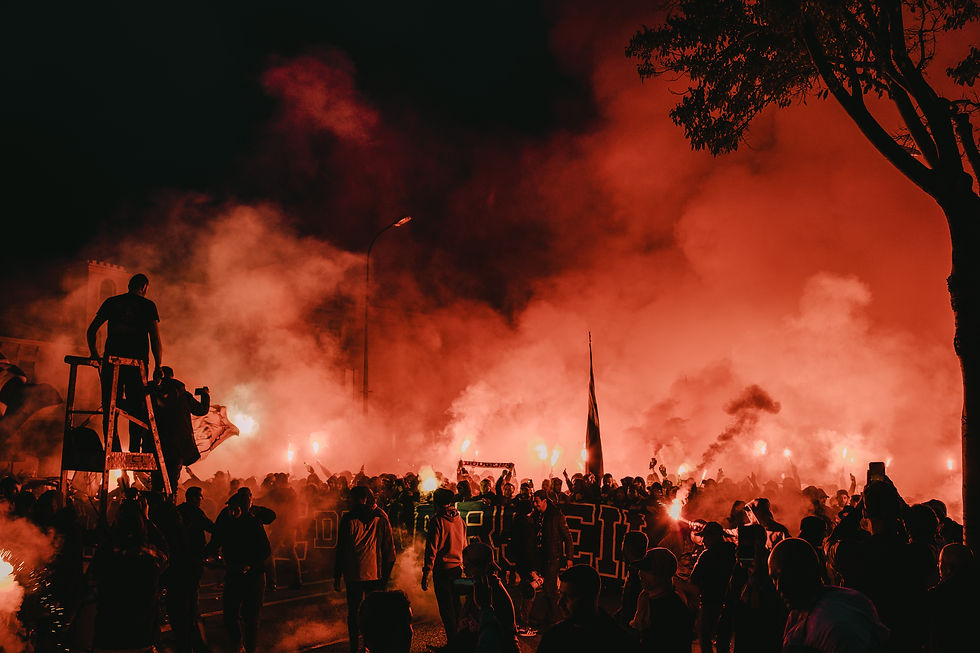
In the past decade, the politics of FC Barcelona has been dominated by the Catalan independence question... much like Brexit dominated the United Kingdom. But, in stark contrast to the muted political noise from English stadiums, Barcelona fans are not afraid to voice their opinion during matches. The 17:14 chant is a perfect example, as a clear metaphor for the way in which many FC Barcelona fans reflect historical events in their modern day political expressions. The idea originates from the Siege of Barcelona by Philip V in 1714, which annexed Catalonia to Spain. The accompanying chant - “In, Inde, Independencia” - sees almost 90,000 fans get to their feet to chant for Catalan independence. It demonstrates that much of the fans’ expression is reflective of a historical feeling of oppression by Spain, and while the extent of the subjugation of FC Barcelona will forever be debatable, the fans’ vocalism makes it difficult for the football club to restrict politicisation without negative consequences.

However, this is not to say that FC Barcelona could not do more to push for a balancing of political expression within core fan areas. The allowance of an Omnium Cultural and ANC concert 'For Freedom' at the Camp Nou is excessive allowance of independentist expression. Furthermore, large political banners (which are generally regulated by stewards throughout Europe) used by fans during UEFA Champions League games are excessively pro-independentist. “Catalonia is not Spain”, unveiled in English rather than Catalan, demonstrates that these banners were seeking an international audience to push independentist ideas. Given that there remains no evidence of a popular vote in favour of independence within Catalunya, allowances of such political bargaining seem unbalanced...
The one hundred and twenty-one-year history of FC Barcelona is drenched in political activity; from its founding in 1899, Rivera's dictatorship, struggles through the Spanish Civil War, suppression under Franco and more recently surrounding the Catalan independence movement, the club has always been the embodiment of Catalonian passion. In the context of the modern day, where elite athletes and sports organisations worldwide generally restrain from much political commentary, FC Barcelona’s openness to its fans’ expression may appear controversial; however, it is crucial to appreciate the club’s historical context and the fans’ personal experiences of the club’s involvement in political affairs. The football club shares a uniquely inseparable relationship between football and politics which transcends the commonly set boundary between sport and society. Barcelona have always been a patriotic symbol of love for Catalunya, but more recently the club have become a catalyst for independentist expression. Their dramatic, intense, volatile experiences with the Spanish state make this ultimately unsurprising; political passion is deeply-rooted in this incredible club's DNA.


Comments