

Ultra Culture - How Spanish Fans Compare to the English...
- Ethan Ferrão
- May 14, 2020
- 7 min read
Updated: May 22, 2020
British football fans are known for their noise, rowdiness and sometimes hooliganism... but Spanish football could not be more contrasting.
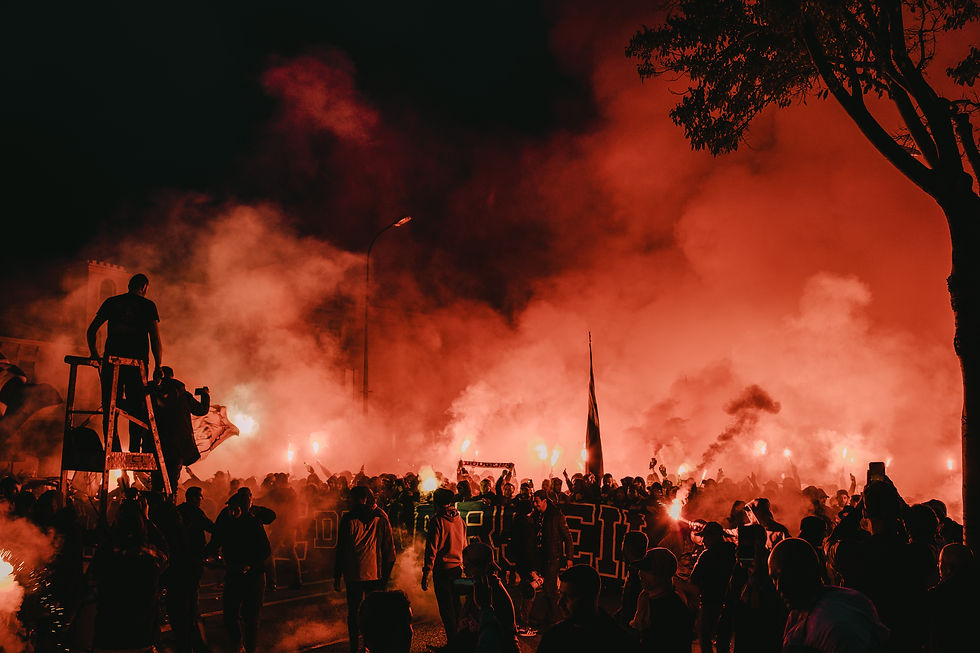
There is a unique essence to English football which only someone brought up on it could truly understand. As a child, being a fan meant travelling to the ground and slowly seeing more people dressed in your club's colours, or soaking in the stench of pies, horse faeces and cigarettes outside the ground, or asking your dad for a few pounds for a programme, then scanning the ticket and walking through the turnstiles before scurrying to your block. The pre-match experience climaxed in that fateful moment as you walk up the stairs from the concourse and see your first glimpse of green on the other side. After kick off, it meant making as much noise as possible, feeling amazed at how close you were to the biggest stars in the game, and occasionally feeling urges to abuse the ref. And that culture persists all the way into adulthood, but you appreciate different things; you recognise a good beer on the terraces, you actually understand tactics, you get that surge of adrenaline when an opposition player celebrates in front of you. Football becomes more about fan interaction and less about what happens on the pitch. It's appreciating club rivalries, travelling up and down the country, supporting your club on freezing weeknights when you can't feel your fingers. Essentially, British football is a modern day form of tribalism. But you’d be sorely mistaken in believing that the tribal culture of British football is reflected globally; in Spain, fans are part of a family.

Before proceeding, it is important that you understand my personal bias and cultural confusion. My love for the English game makes any alternate fan culture a difficult one to interpret. I openly admit that the criticism of Spanish fans which follows is unfair. It's an outsider's perspective, and that's all it is meant to be. So take what I say or argue with a generous pinch of salt; my opinions are merely the result of an inescapable patriotism to my upbringing in English football.
From the moment I walked through the gates of the Santiago Bernabéu, hiked up eight flights of stairs and took my seat in the upper terrace, I recognised that an English football fan would not belong here. I was surrounded by three groups of people:

Firstly, there were the elderly cigar smokers - The Godfathers. These weren't the type of men to get up off their seats as Eden Hazard approached the edge of the box, nor were they the type to start chants or abuse the opposition. They were often solitary, sat by themselves in silence. They were there to watch their team poker-faced while smoking gigantic cigars and eating nuts. They were the type of people who have sat in the same seat for 45 years, and turn up to every home game with the same deadpan facial expressions. You could tell a lot of them knew each other, but they would greet one another with a simple nod of acknowledgement, rather than a friendly smile. Needless to say, they were a far cry from the foul-mouthed, boozed-up British grandads you generally meet on an English concourse. Each to their own, but I have to admit I prefer the buzz of the British fans...
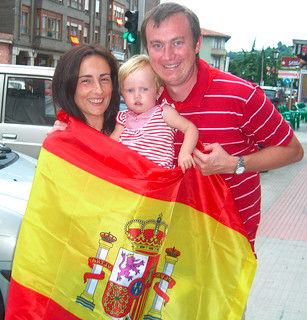
Then there were the families: mothers, fathers, sons and daughters. It was at the Estadio Metropolitano for a Champions League match between Atletico and Juventus that I had a small run in with this group. As Joao Felix dribbled the length of the pitch, almost scoring one of the best goals I've ever seen, I stood to my feet about 10 rows behind the goal. Shouts of 'perdón!', 'disculpe me!' and 'muévete!' were hurled at me by a family in the row behind, urging me to stay sat, not because their children were too small to see, but purely because standing up is not part of their fan culture. Again, this mildly irked me. Further cementing my cultural confusion, I looked around to see dozens of Juventus fans sat around me, in one of the most blatantly obvious 'Home' sections. How did I know they were Juventus fans? They celebrated goals from Cuadrado and Matuidi, they spoke Italian, and, unbelievably, they were openly wearing Juventus kits with Ronaldo's name printed on the back. What's worse, when Hector Herrera headed in a 94th minute header to equalise at 2-2, every fibre of my being wanted to charge down to the front to celebrate. But I knew that such a British reaction would not be well received...
Before discussing the final set of fans I noticed in Spain, I would like to point out that the two groups I have discussed already are the most organic fans that the country produces. It is not for me to judge what is good support or not, and I certainly cannot criticise these fans who are clearly die-hard. Their love for their club is harder to understand, it's not as visual as a hardcore English fanbase who've travelled in their thousands across the country for the sake of packing out an away end. But it's a totally different way of treating a football match, and I believe we can all learn something from each other. From the Spanish, we can learn to treat football as it is known - 'The Beautiful Game'. Appreciating the history and traditions of your club and your stadium, and being part of a more peaceful and friendly community of fans than the bustling noise of an English crowd. From the English, Spaniards may take the hilarity of jeering a wayward shot from an opposition player, or building up to yell at the opposition keeper as a goal kick is being taken. But there are much larger, more striking differences that we can see in the last group of fans: the Ultras.
Did you know: Spanish fans don't have chants for players', only for their club. There's no such Will Griggs action here... (unless it's Lionel Messi)
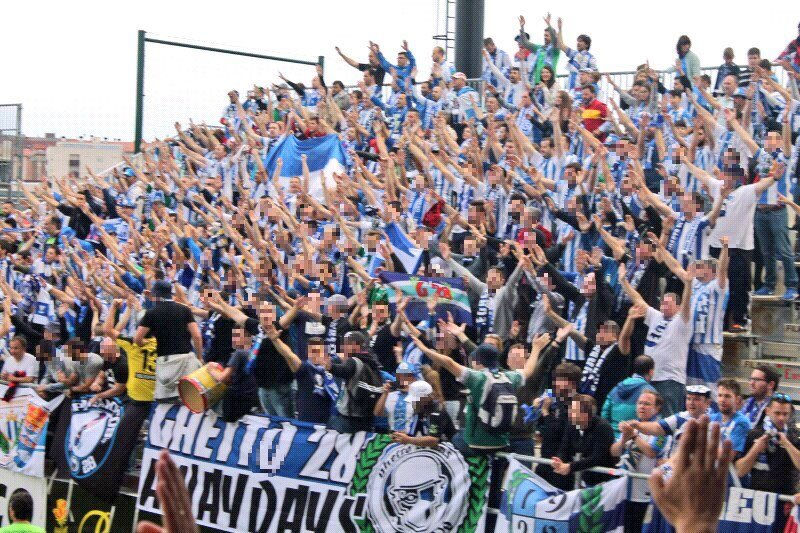
My first hand experience of Spanish ultras came at the Estadio Burtaque and the Coliseum Alfonso Perez with CD Leganés. This quaint club in the south of Madrid, with a a stadium capacity of only 12,454, is the heart of the community. But in the western corner of the Fondo Norte are the ultra groups, with drums, flags, scarves and a loudspeaker. From kick off until the final whistle, they do not stop chanting, shouting, banging and literally drumming up an atmosphere. In many ways, the noise they produce is a spectacular performance, and I had the luck to experience it both as a fly on the wall (Celta Vigo and Levante at home) and as a part of the pack (away at bitter rivals Getafe). It is, in many ways, the part of the Spanish fan experience which feels closest to home. It's a derivation of hooliganism; the most visual, deepest and truest expression of support for your football club. Being a part of the away fans in a sold out allocation in the Derbihistorico was something to relish, and it was an unforgettable experience. But, if you're like me, and feel that fanhood should never be just a 'performance', then you will appreciate my scepticism surrounding Spanish ultra culture.
In many cases, the ultras of a club are blatantly inorganic. Real Madrid banned their core fan group after protests against club president Florentino Perez, which, aside from the point, is simply anti-football fans. They were replaced with a thousand strangers wearing white shirts, with plastic flags and some scarves. You will notice that at every home game, the bottom tier of the Bernabeu will feature a section of self-proclaimed 'ultras', but in many ways that's farcical. Furthermore inorganic is the fact that every club in La Liga has its own ultra group. It is obvious, at times, that clubs feel pressured into forcing ultra groups into their stadium as part of bolstering public relations. They are a spectacle for the cameras, and while they are often passionate, chanting for 90 minutes non-stop can be seen as a chore. I would also question the limits on the capacity of ultra groups; in England, a club with 10,000 die-hard fans will have a 10,000 strong group of loud, buzzing supporters. But in Spain, if you are outside the dedicated ultra-section, you can't consistently chant without being obviously out of place. Unfortunately, my criticism doesn't stop there...
On the 11th of October, as I was making the 1 hour metro trip to the Estadio Burtaque to purchase my away ticket for Getafe, I felt as stressed as any English fan would: I am not a core fan, I do not have a season ticket, I do not have any loyalty points, I barely speak Spanish, I don't own a Leganés shirt or scarf. How would I get a ticket for the biggest away day of the season when the allocation is only 500? And as the bus pulled into the stadium, I saw no one. Not even signs to the ticket office. I strolled into the club shop, asked about tickets in incredibly poor Spanish, bought two tickets and left without a hassle. And while the Derbihistorico was the experience of a lifetime, one has to question how on earth that happened if the ultras are really as die-hard as they proclaim. Away support in Spain is horrific, with Real Madrid taking only 11 fans to Granada in 2016. Maybe that's something they can adopt from the English game...
The way you support your football club is often an expression of your personality. Perhaps that's where the true difference lies. Are Spanish fans a projection of a more family oriented society, with ultras being an aberrational, average mimic of English hooliganism? Are the Spanish stands more inviting for the football neutral? Personally, I simply cannot escape my individual bias. My perception of support has been shaped by two decades of following a club in the Premier League and the Championship. I adore English fan culture. I haven't been to anywhere near as many away games as a lot of the fans I know, but I've certainly travelled more miles than most Spanish fans. And I don't say that to be egotistical; the two fanbases are in stark contrast to one another, and you'd have to ask a Spaniard to truly understand what good support is in Spain. As we sit at home today, desperately missing football, I'm sure that the Spanish miss supporting their club just as much as I do, but until fans are allowed back into the stadium, it'll be English fan culture that I long for most.


Comments